
Image understanding
Choose the dedicated DeepSeek Vision Responses model or a custom OpenAI-compatible endpoint. Image detail, credential state, limits, usage, and privacy remain explicit.
CodeSeeX exposes a bounded set of hosted tools, preserves Codex-native client tools, and keeps community tools behind explicit local trust boundaries.
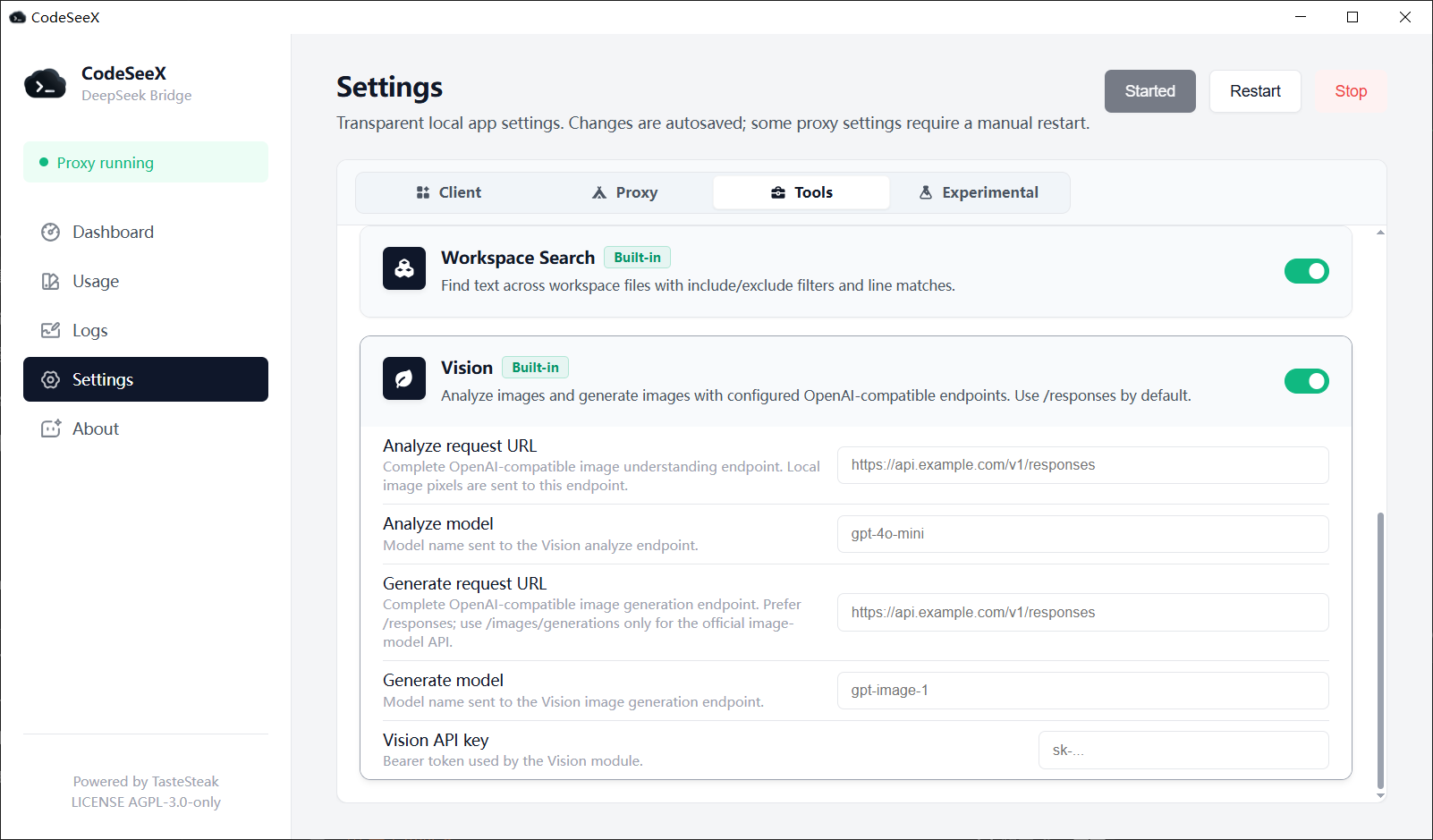
Separate DeepSeek Vision or custom image understanding, plus an independent image generation endpoint.
Choose the dedicated DeepSeek Vision Responses model or a custom OpenAI-compatible endpoint. Image detail, credential state, limits, usage, and privacy remain explicit.
Enable image_gen separately with its own endpoint, model, and credential. Selecting DeepSeek Vision never changes the generation provider.
Vision usage is a separate session phase. Default logs keep counts and normalized usage, not original images, base64, API keys, full prompts, or full provider responses.
Choose CodeSeeX web scraping or the official DeepSeek Search/Fetch API. Both are CodeSeeX-hosted and return bounded evidence to the model.
Read-only file and repository inspection tools support large-codebase reasoning without turning every operation into a shell script.
Patch application is handed back to Codex in the expected client-tool shape, with repeated failure diagnostics instead of silent loops.
Separate DeepSeek Vision or custom image understanding, plus an independent image generation endpoint.
Local command manifests under ~/.codeseex/extension/tools are disabled by default and require explicit trust.
Diagnostics store summaries and hashes where possible, not raw prompts, image data, or full tool output.
Tool access is useful only when the runtime can keep it bounded, observable, and scoped.
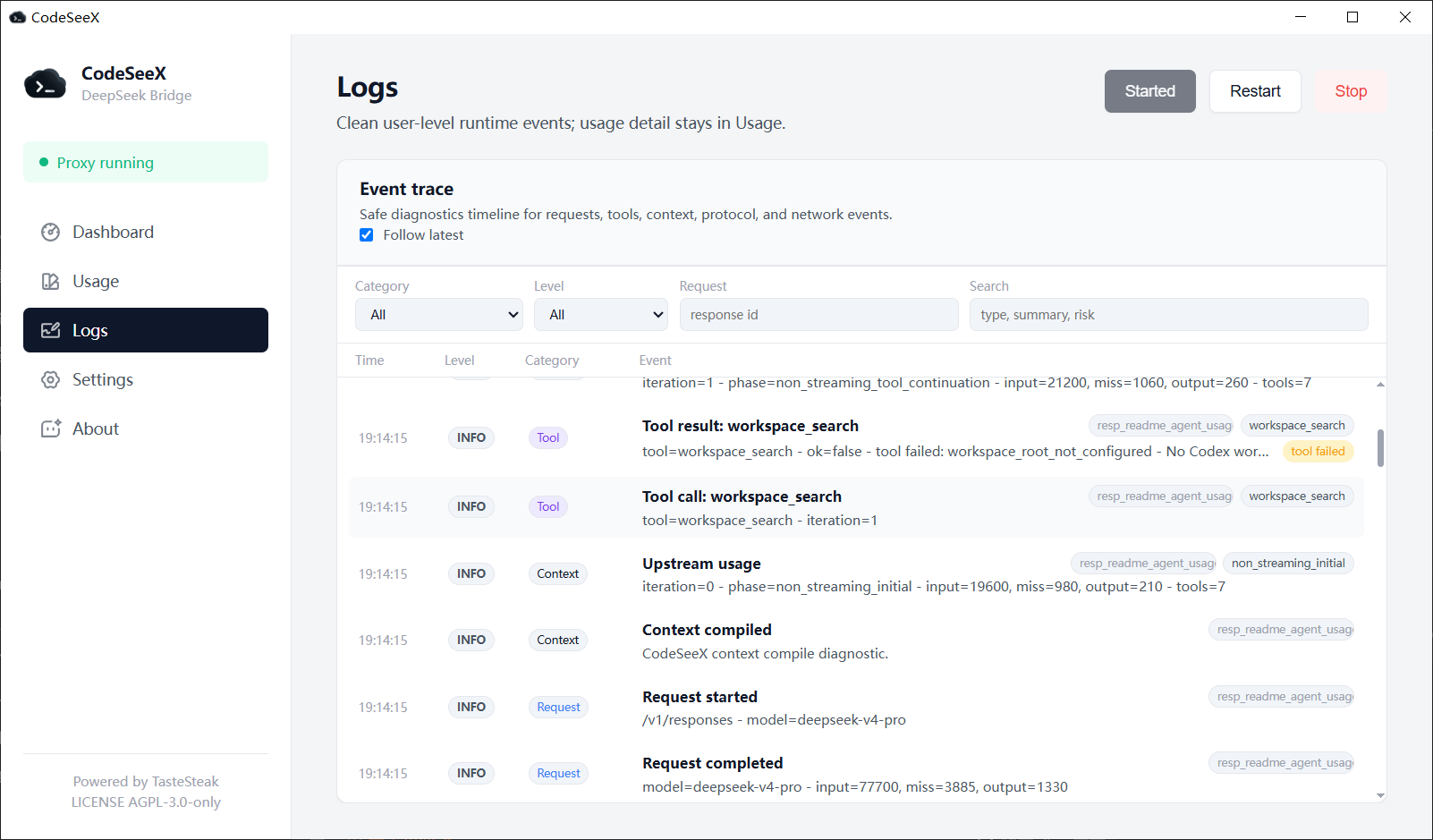
Local command manifests under ~/.codeseex/extension/tools are disabled by default and require explicit trust.